
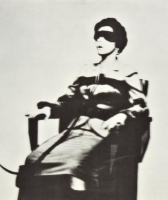
Bloody Babs, portrayed as a blood-thirsty femme fatale, was executed in the San Quentin Rehabilitation Center’s gas chamber at just age 31. She left behind an unkind and unfair world, the memory of a woman who was wrongfully portrayed, and some hauntingly true last words.
Who was Bloody Babs?
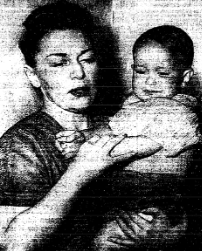
Barbara Elaine Ford, later known as Barbara Elaine “Bonnie” Wood Graham—and nicknamed “Bloody Babs”—was born June 26, 1923, in Oakland, California. Her mother, Hortense Ford, was just 17 at the time of her daughter’s birth, and Barbara’s younger sister, Claire, was born two years later. By age 19, Hortense was raising two daughters, with Barbara quickly gaining a reputation for being rebellious and constantly attracting attention, especially from men, which frustrated her mother. Throughout her childhood, Barbara was sent to strict and punishing schools to correct her behavior, but she frequently ran away and returned home, only to be sent away again. Eventually, Barbara left for good. By 17, Barbara was married and became a mother herself, but her marriage to U.S. Coast Guardsman Harry Kielhamer ended in divorce by 1942, leaving her a single mother. Soon thereafter, she remarried and had 2 additional sons. However, this marriage also ended in divorce. By 1951, Barbara was raising three sons on her own and had already been arrested for prostitution, petty crime, drug use, perjury, and check fraud—often motivated by the need to support her family. She worked a variety of jobs before falling in with a group planning to rob the home of wealthy widow, Mabel Monohan, in Burbank. On March 9, 1953, Barbara and her accomplices broke into Monohan’s home, intending to steal rumored gambling money. The robbery turned violent, and Monohan was killed during the crime. Barbara was arrested, and her trial attracted widespread media attention. Dubbed “Bloody Babs” by the press, she maintained her innocence, but evidence and testimonies—including that of a police informant—contributed to her conviction. Graham was found guilty of first-degree murder and sentenced to death in California’s gas chamber. She was executed at San Quentin on June 3, 1955. Her last words remain haunting to any who read them: “Good people are always so sure they’re right.”
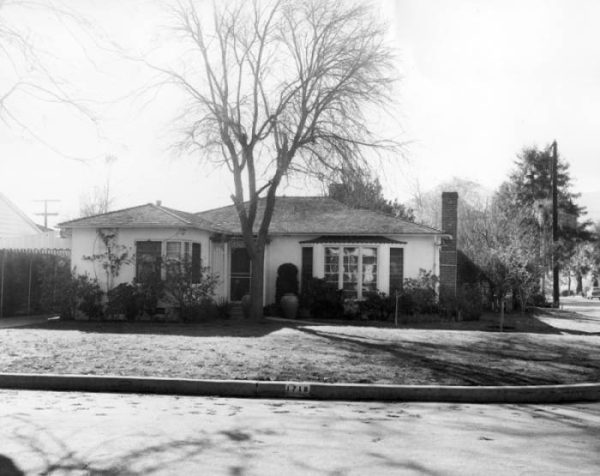
What was the Mabel Monohan Murder?
After Graham’s fourth husband, bartender and heroin addict, Henry Graham, introduced her to Emmett Perkins (a minor player in LA mobster Mickey Cohen’s operation) and his associate, Jack Santo, she began working in their illegal gambling parlor. Jack Santo recruited Graham, Perkins, John True, and safe-cracker, Baxter Shorter, to rob Mabel Monohan’s home, targeting a safe believed to hold $100,000 from her former son-in-law, gambler Tutor Scherer.
On March 9th, 1953, Graham approached the house and rang the bell. Ironically, when Barbara Graham first approached the house at around 6:00 pm, Monohan was reading a murder novel titled The Purple Pony Murders. Graham played the part of an anxious, young woman with car trouble who wanted to use the phone. Monohan, being a suspicious and anxious person, had to be coaxed by Graham to open the door. Once she did, all of Graham’s cohorts (except for Baxter Shorter) burst through the door and began ransacking the house. At some point, a pillowcase or sheet was torn into strips and used to gag and bind Monohan. She was hit with either a pistol or her own cane. Once she awoke, she was dragged around the house and asked to tell them where the safe was. She either didn’t know or wasn’t willing to share. A pillowcase was placed over her face before the group left. When authorities found her (after being called by her worried gardener), they found Mabel’s body and the pillowcase. Both were soaked in her blood. Mabel had died sometime after the criminals left.
The Media Frenzy and Public Perception
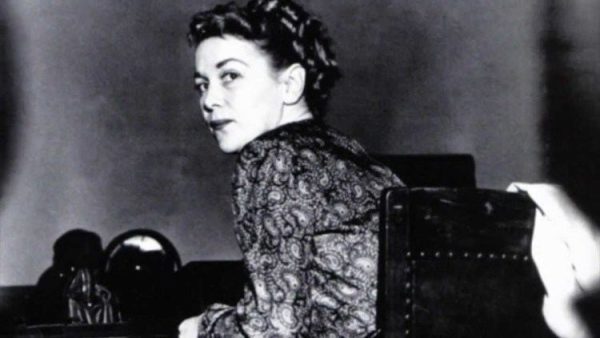
Barbara Graham was portrayed as a blood-thirsty murderess who wanted nothing more than to keep herself alive and preferably wealthy. This isn’t who she was…or was it?
Mabel Monohan’s murder and the involvement of a female criminal sent the media into a frenzy. Female criminals were much rarer than male criminals throughout the 60s and proceeding years. Only 3%-8% of criminals were females between the 1920s and the 1960s. The motives, backstories, and traits of male killers were pretty well-known, but those of female killers were not. Graham originally claimed to have taken no part in the robbery of Monohan’s house or her murder. However, Graham’s credibility was destroyed when she tried to fabricate an alibi, as she did not know the person she paid was a police officer recording her confession to being at the scene. Barbara Graham was given many nicknames, like “The Blonde Iceberg.” “The Gun Moll,” “That Monster Disguised as a Woman,” and the most well-known, “Bloody Babs.” The press frequently pointed out her high heels and red lipstick, as opposed to the details of the crime, which framed her as a dangerous, “sultry” woman. To this day, it is believed that Barbara Graham did everything she did not just to keep herself wealthy and comfortable but in order to protect her broken family and the relationships that she was still able to hold onto. We may never know who the true Barbara Graham was. The terrible image she was given by the media darkened the already cloudy life of a woman who only wanted the safety of herself and her family.
Her Accomplices and Their Endings
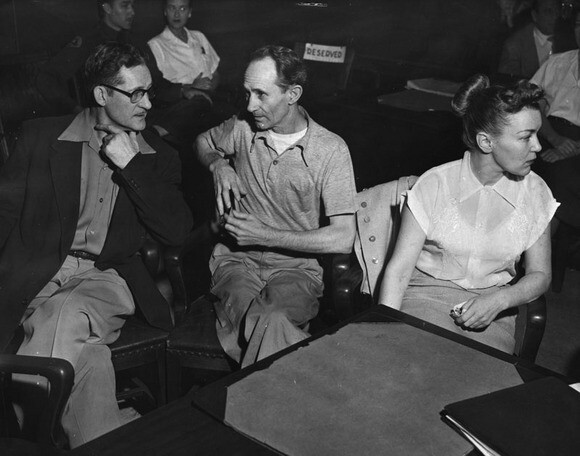
Barbara Graham’s accomplices included Baxter Shorter (an expert safe-cracker and the assigned lookout during the robbery of Monohan’s house), Emmett “The Weasel” Perkins (an experienced criminal who had many prior felonies and a few connections to different mobsters), Jack Santo (another known criminal with a history of involvement in robberies and other crimes), and John True (a deep-sea diver and a man who was often involved in the criminal enterprise). When the crew was done robbing and assaulting Mabel Monohan, Baxter Shorter called the authorities, fearing Monohan would die. Shorter was called into a police station and confessed to being at the scene of the crime. He named all of his accomplices and was given immunity. After finding out that he ‘snitched’, Emmett Perkins and an unknown get-away driver kidnapped Shorter from his apartment and killed him before he could testify against Perkins and the other criminals. Shorter’s wife, Olivia “Olive” Shorter, saw her husband get kidnapped and pointed out Perkins in court. John True was eventually arrested and taken into custody in Grass Valley, where he claimed to not have known any of his accomplices, except Jack Santo. He verified the list of suspects who partook in the robbery. After testifying against Perkins, Santo, and Graham, True was never arrested again. The trio of criminals left were all executed in the San Quentin gas chambers on June 3rd, 1955. Barbara Graham was executed early in the morning and the men were executed later that same day. Emmett Perkins’ last words were the following, spoken to the police officers present, “Now don’t you boys do anything I wouldn’t do.” Perkins and Santo’s last moments are described as being less dramatic and more simple than Graham’s (displaying the often sexist views of the 50s).
Conclusion
The story of Barbara Graham, infamously remembered as “Bloody Babs,” is a haunting intersection of crime, media sensationalism, and the complexities of human nature. While Graham’s involvement in the Mabel Monohan murder remains shrouded in controversy and conflicting narratives, her enduring legacy is shaped as much by the era’s hunger for scandal as by the facts of the case. The press’s relentless focus on her gender, appearance, and tumultuous past painted a portrait that may never fully reflect the woman behind the headlines. Ultimately, Barbara Graham’s tragic end and her chilling final words, “Good people are always so sure they’re right,” serve as a reminder of how easily truth can be obscured by public perception and how the search for justice can be clouded by sensational storytelling. The real Barbara Graham, like so many figures cast in the harsh light of notoriety, remains an enigma—forever trapped between myth and reality.
References:
- Renner, J. (2013, June 5). They did it for money: The mob-style murder of Burbank widow Mabel Monahan. LAmag. https://lamag.com/crimeinla/they-did-it-for-money-the-mob-style-murder-of-burbank-widow-mabel-monahan/
- Linn, S. (2021, July 8). Proof of guilt: The tragic life and public death of Barbara Graham. PBS SoCal. https://www.pbssocal.org/shows/artbound/proof-of-guilt-the-tragic-life-and-public-death-of-barbara-graham
- Riter, J. (2025, May 28). Las Vegas casino pioneer a footnote in Southern California slaying. The Mob Museum. https://themobmuseum.org/blog/las-vegas-casino-pioneer-a-footnote-in-southern-california-slaying/
- Los Angeles Times. (2000, January 1). A century of crime. Los Angeles Times. https://www.latimes.com/socal/burbank-leader/news/tn-blr-xpm-2000-01-01-export18408-story.html
- Stanford Law School – Robert Crown Law Library. Supreme Court of California. (n.d.). https://scocal.stanford.edu/opinion/people-v-santo-24624
- U.S. depar1ment Ofjustice Bureau of Justice Statistics State and federal. (n.d.). https://bjs.ojp.gov/content/pub/pdf/sfp2585.pdf
- Crime rate of women up sharply over men’s (published 1971). (1971). https://www.nytimes.com/1971/06/13/archives/crime-rate-of-women-up-sharply-over-mens-crime-rate-of-women-up.html
- Parcast Studios. (Producer). (2023, November 13). Bloody Babs Pt. 1 [Audio podcast episode]. In Serial Killers. Spotify. https://open.spotify.com/episode/3gCrvpHAm1vwtzhD2jpxqy
- Parcast Studios. (Producer). (2023, November 20). Bloody Babs Pt. 2 [Audio podcast episode]. In Serial Killers. Spotify. https://open.spotify.com/episode/7cL8U667kgfZTphkuDyfzy