

















College basketball is one of America’s favorite sports, and March Madness is America’s favorite college basketball tournament. The 2026 NCAA men’s basketball tournament has long since concluded, providing another entertaining and chaos-filled entry in college basketball’s most prominent postseason tournament. 68 teams participated in the tournament, colloquially referred to as March Madness for its many bewildering and exciting moments. This year’s tournament, however, did not feature much chaos, though it was certainly a more interesting tournament than last year’s, at least in the eyes of many. With this being the final tournament before the NCAA expands the format to 76 teams starting in 2027, it is time to conduct a brief overview of the 2026 edition of March Madness.
The process for all 68 teams to enter the tournament began long before the actual tournament itself, in their competition through the regular season and any conference tournaments they participated in. Over 300 Division 1 basketball teams competed against one another for spots in the tournament, and many were left behind in the dust as teams continued to advance ahead of them in record and poll rankings. Even still, many interesting stories arose from the regular season, the most notable of which being that of the Miami (OH) RedHawks. A traditionally middling team in the Mid-American Conference, Miami (OH) stunned the college basketball world by posting an undefeated 31-0 record in the regular season, however was never able to make it far in the MAC tournament, losing in a stunning upset to the UMass Minutemen in the first round. Other teams across the nation also made statements as they posted strong records. These included the Arizona Wildcats, Florida Gators, UConn Huskies, Illinois Fighting Illini, and Michigan Wolverines. Mid-major teams, teams from non-power conferences, were also a strong force in the regular season, such as the Gonzaga Bulldogs and Utah State Aggies.

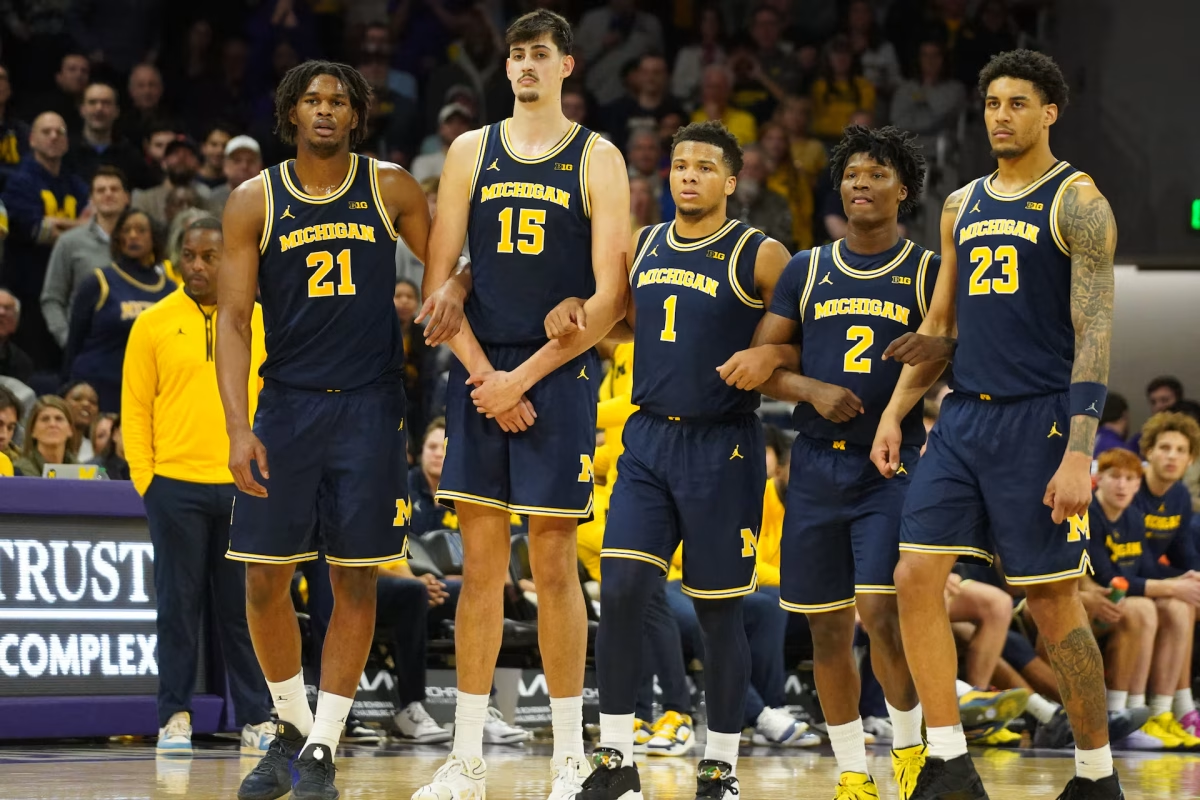
Conference tournaments soon began in early March, and the winners of each conference tournament would receive an automatic bid to March Madness. Most conference winners, those of low-major or mid-major conferences, received lower seeds, typically between 12-16. Other teams who didn’t win their conference tournament, but still showed talent throughout the season, were also able to make it in with at-large bids, and some of these teams were very highly regarded. For example, even though Michigan was unable to win the Big Ten tournament, they were still awarded a #1 seed for their amazing performance in the regular season, going 29-2 during that time-span. All conference champions, numbering 31 teams (32 prior to the collapse of the Pac-12 Conference in 2023-24), were determined by the time Selection Sunday came around. Selection Sunday is the day in which a committee chooses who gets the remaining 37 at-large bids. The Duke Blue Devils would receive the top overall seed in the tournament with the other #1 seeds, including the aforementioned Michigan, Arizona, and Florida. The tournament was set, and play began during the week of March 17th.
First up were the so-called First Four, meant as play-in matches for lower seeded teams. For the 11th seed in their regions, Miami (OH) would face SMU, and Texas would face NC State. For the 16th seed in their regions, Prairie View A&M would face Lehigh, and UMBC would face Howard. In the end, Miami (OH), Texas, Howard, and Prairie View A&M advanced forward. All teams but Texas would lose in the first round to higher seeded opponents. Moving onto the first round, a traditionally upset-heavy section of the tournament, very few upsets actually took place. #12 High Point beat #5 Wisconsin by one point, #11 VCU came from behind to take down #6 North Carolina, and Texas upset #6 BYU. The second round saw a stunning upset of defending champions Florida at the hands of #9 Iowa, allowing the Hawkeyes to slip into their first Sweet Sixteen since 1999. Other noteworthy moments during this round included Texas’ upset of #3 Gonzaga, and a high stakes match-up between #5 Vanderbilt and #4 Nebraska.

The second weekend consisted of the Sweet Sixteen and the Elite Eight. Chaos remained abound in the tournament, as shown during the Sweet Sixteen. Texas’ luck finally ran out against a championship contender in #2 Purdue. Tennessee had also begun an unlikely run of their own, with the #6 squad first beating down Miami (OH) and #3 Virginia in the first weekend, before taking out #2 Iowa State during the Sweet Sixteen to advance forth. Match-ups, such as Illinois’ victory over Houston and Iowa’s stunning upset over Nebraska, helped the chaos continue into the Elite Eight. Illinois would end Iowa’s run in dominant fashion, as did Michigan with Tennessee. Arizona also took care of business against Purdue, and UConn would come from behind and upset Duke off an improbable buzzer beater with less than a second left on the clock.
The Final Four was set. #3 Illinois made their first Final Four since 2005. #2 UConn returned to the Final Four for the third time in four years. #1 Michigan had made their first Final Four since 2018. #1 Arizona had also made their first Final Four since 2001, ending a 25 year drought. Illinois and UConn first squared off for a spot in the national championship, with the Huskies knocking off the Illini to make their third national championship in four years. Afterwards, Michigan would face Arizona for the final spot in the title game, with the Wolverines preventing the Wildcats from making it in. UConn and Michigan would thus be squaring off for the national championship on April 6th, 2026, 3 weeks after the beginning of the tournament. After a hard-fought battle on the hardwood, it would be Michigan who rose to the top of the college basketball world, beating UConn 69-63 and claiming their first national championship in over three decades.

With Michigan’s newfound basketball title, the Big Ten became only the second conference ever to sweep the national championships in both basketball and football (the Indiana Hoosiers’ first title), men’s basketball (Michigan’s aforementioned title), and women’s basketball (UCLA also winning their first title this year). The only other conference to do so was the Southeastern Conference in 2007; Florida won both the BCS National Championship and the men’s basketball title, and Tennessee reigned supreme over women’s basketball. The 2025-26 season is, as mentioned previously, the last before the NCAA expands both the men’s and women’s tournaments to 76 teams starting in 2027. With all the controversy surrounding the sport of college basketball, only time will tell what happens next and who will soon rise to the top and claim a crown of their own.
References:
Clapp, Matt. “First Four Brings in Record-Setting Viewership.” Awful Announcing, 21 Mar. 2026, awfulannouncing.com/cbs/march-madness-first-four-record-viewership.html. Accessed 11 May 2026.
“Iowa Beats No. 1 Seed, Defending Champ Florida in Second Round of March Madness | FOX Sports.” Foxsports.com, 2024, www.foxsports.com/stories/college-basketball/iowa-beats-no-1-seed-defending-champ-florida-second-round-march-madness. Accessed 11 May 2026.
Medcalf, Myron. “Men’s March Madness 2026 Bracket: Get to Know All 68 Teams – ESPN.” ESPN.com, ESPN, 15 Mar. 2026, www.espn.com/mens-college-basketball/story/_/id/48156563/march-madness-2026-every-team-mens-ncaa-tournament-bracket-explained.
“NCAA College Basketball Rankings: AP Top 25 Basketball Poll.” AP NEWS, apnews.com/hub/ap-top-25-college-basketball-poll.
“No. 19 Miami (Ohio) Caps Undefeated Regular Season with OT Win – ESPN.” ESPN.com, ESPN, 7 Mar. 2026, www.espn.com/mens-college-basketball/story/_/id/48128883/no-19-miami-ohio-caps-undefeated-regular-season-ot-win. Accessed 11 May 2026.
“Wolverines Triumph over Huskies to Win Second National Championship – University of Michigan Athletics.” University of Michigan Athletics, 2026, mgoblue.com/news/2026/4/6/mens-basketball-wolverines-triumph-over-huskies-to-win-second-national-championship.